
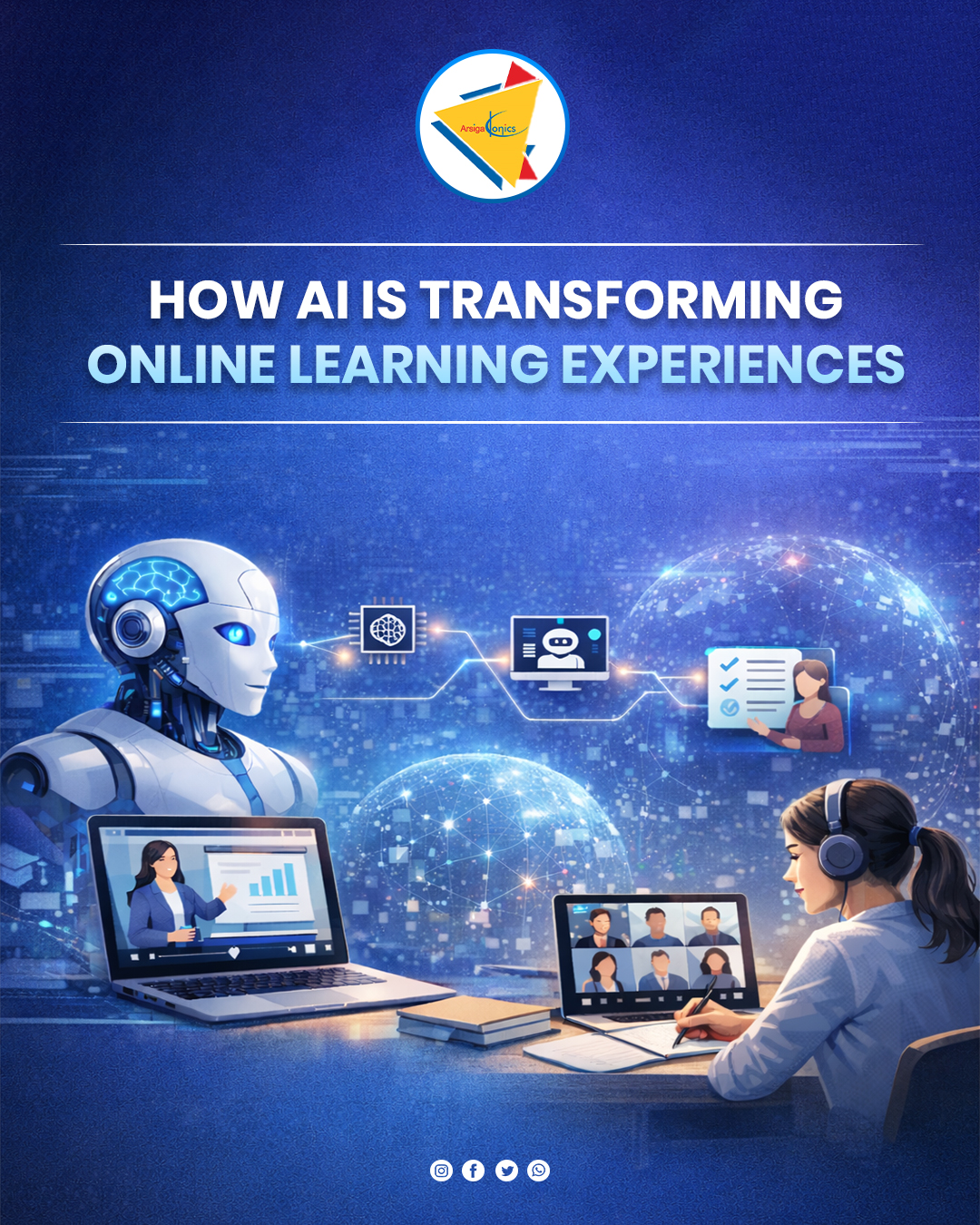
Artificial Intelligence (AI) has taken over almost all industries, including education. E Learning has become smarter, personlised and more engaging. AI’s intelligent tutoring systems has transformed the way learners consume, interact with, and benefit from digital education. Lets us learn how AI is transforming online learning experiences:
- Personalisation:
AI has bought about personalisation in online learning. AI platforms analyse a learner’s behaviour, preferences and performance in real time, and based on this data, customised learning modules with suitable difficulty levels is offered. This personalisation ensures that each learner progresses at their own pace, improving retention and overall learning outcomes.
For example, if a learner struggles with a particular concept, AI can offer additional explanations, practice exercises, or microlearning modules. Conversely, fast learners can skip redundant content and move ahead.
- Intelligent Tutoring and Virtual Assistants:
AI-driven tools like virtual tutors and chatbots provide instant support by answering questions, explaining concepts, and guiding learners through complex topics. These tutors are available anytime and anywhere, unlike human instructors, and the AI tutors can manage multiple learners at the same time.
- Natural Language Processing (NLP):
NLP allows AI systems to understand learner queries in conversational language. This makes interactions more intuitive and reduces learner frustration. Further, it enhances engagement and creates a supportive learning experience.
- Data-Driven Insights for Better Learning Design:
AI also empowers instructional designers and educators to refine content, improve assessments, and optimize course structure. The data-driven insights enable the educators to make data-backed decisions to enhance course effectiveness and learner satisfaction
- Adaptive Assessments and Real-Time Feedback:
AI enables adaptive assessments that change dynamically based on learner responses. If a learner answers correctly, the system presents more challenging questions. If not, it revisits foundational concepts. AI also provides instant, personalized feedback. This real-time feedback loop encourages continuous improvement and helps learners stay motivated throughout their learning journey.
- Enhanced Engagement Through Immersive Technologies
AI is also driving immersive learning experiences through technologies such as Virtual Reality (VR), Augmented Reality (AR), and Gamification. AI-driven simulations can replicate real-world scenarios, allowing learners to practice safely and gain confidence. Gamified elements, such as adaptive challenges and personalized rewards, further boost motivation and participation.
- Improving Accessibility and Inclusion:
AI is making online learning more inclusive. Special features such as automated captions, real-time translation etc. help learners with disabilities or language barriers access content more easily. AI tools offer unbiased learning opportunities for diverse audiences.
To conclude, as AI continues to advance, online learning will become even more intuitive, predictive, and learner-centric, creating seamless and highly effective learning experiences. However, AI will not replace educators, but enhance their ability to deliver more impactful learning.




Leave A Comment